
Twenty-five years ago I sat across from my first Medicare client, a retired elementary-school teacher who slid a two-inch stack of enrollment forms across the table and said,
"I've taught math for 30 years - but this is Greek to me."
That moment launched what would become CalHealth.net: a mission to translate health-insurance jargon into real-world guidance for Californians.
Fast-forward to 2025.
As licensed California health agents, we've helped more over 10,000 Californians find the right coverage, earned 5-star ratings on Google reviews (individual experience may vary), and watched Medicare rules change almost every Autumn.
When you understand how the pieces fit - Original Medicare, Supplements, Advantage plans, Part D, Medi-Cal, IRMAA-you can choose confidently and often save thousands of dollars a year.
This book condenses the questions we hear daily on our hotline into plain English.
My promise: straightforward facts without hype or pressure
Just the facts, California-specific insights, and effective approaches for managing your costs.
I hope it turns your Medicare confusion into clarity - and maybe frees up
time for more important things, like catching a sunset at Huntington Beach or
hitting a wine-tasting in Napa.
Dennis Jarvis (Licence #0C65199)
California is like no other state and even though Medicare is a federal program, there are quirks to know in our state!
This is that Guide. Sure, we'll cover all the basics of Medicare in an easy to understand way while hitting the local highlights!
Stick with us and you'll be able to navigate it and find the best fit for your situation and budget.
Lots of helpful tips along the way!
We'll cover these topics (click on links to go right to the topic! Chapters 1-4 are really essential):
Many guides out there take forever to get to the point expecting you to spend hours to listen to their stories! Not us!
Let's get right into it.
This is the main show.
Original or Traditional Medicare is the first piece to understand since it drives all other decisions.
This is the part that is provided by the government through Social Security.
It's broken up into two parts:
Part A is usually automatically enrolled when you take Social Security or become newly eligible (typically when turning age 65).
Part B requires a separate "opt in" and usually costs extra to have. You can enroll right through this link or at the local Social Security office.
Part A is generally free if you or a spouse have paid into the system through payroll taxes for a period of time.
The cost for Part B depends on prior income. They look back two years. I'm writing this April of 2025 so the year in question would be 2023 (taxes filed April 2024).
The current maximum IRMAA amount is around $628, but remember, costs like the standard Part B premium and IRMAA can change each year based on factors like inflation and federal updates.
Social Security will give you the exact amount for your situation when you access the link above.
You just submit the SSA-44 form here.
Okay...so Part A and B. That's core Medicare.
What do they cover?
Essentially, they work like 80/20 plans with deductibles built in for both.
So far so good...not too confusing!
Sure, there are other carve-outs like pints of blood and preventative but the main takeaway is the 80/20 split with deductibles.
That's where the real money is!
You'll notice that medication (out-patient from a pharmacy) are not mentioned. That's a separate section we'll cover below (Part D).
So...what's the issue with just having Medicare by itself?
It's the 20%!!
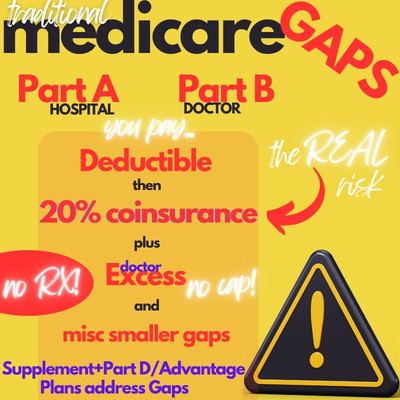
There's no cap to this exposure so...
See the issue? That's why many people consider additional coverage since healthcare needs increase with age.
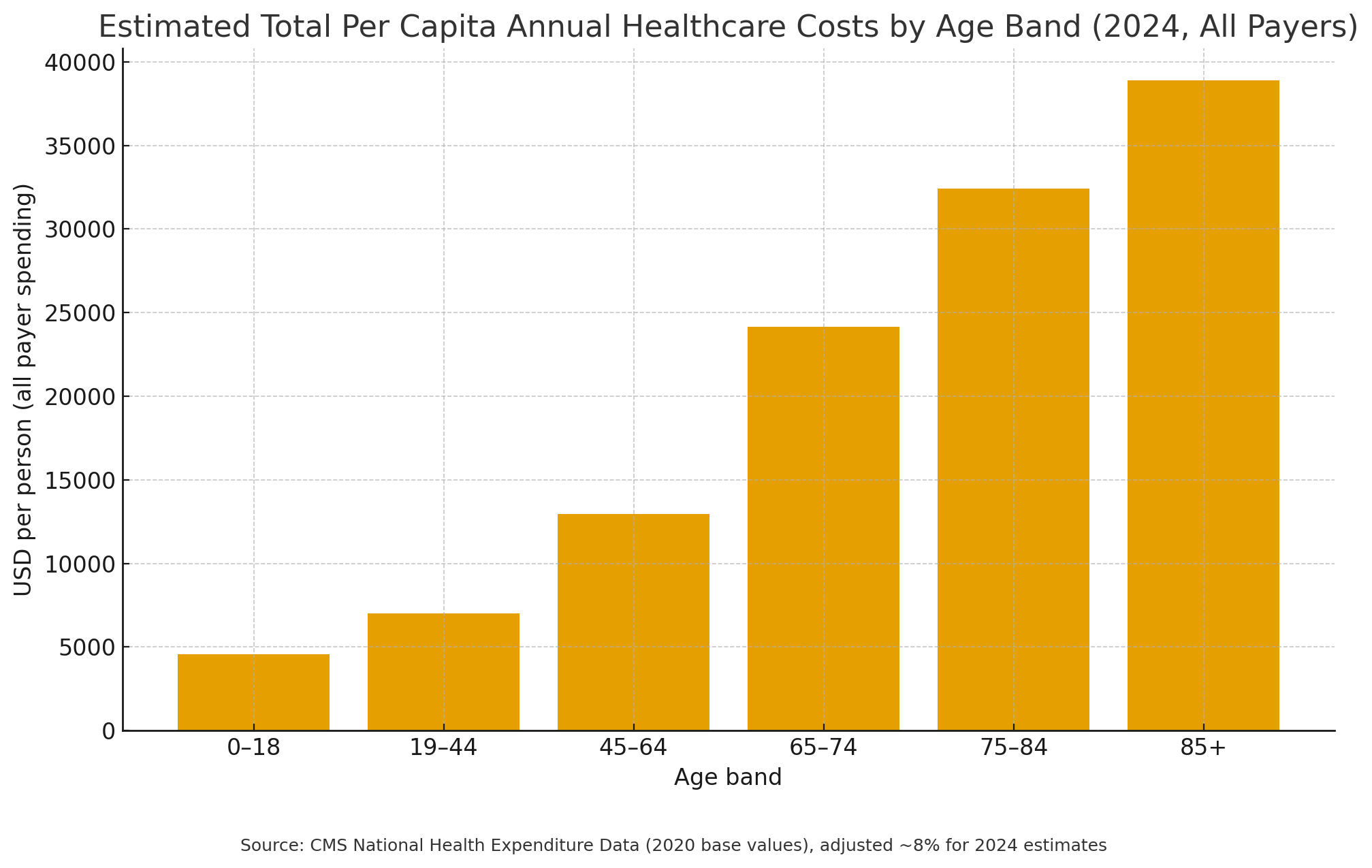
It makes no sense to take on this exposure if we have options that "fill in the gaps" of Medicare.
That then brings up the big decision and one you'll get bombarded with in terms of mailers and ads.
This really is the big decision to make.
We're going to boil down the basics but reach out to us with specific questions and concerns.
We'll wrap this section with a nice little bow on what really pushes the decision one way or another in practical terms.
What does this really mean??
It comes down to network and control over healthcare decisions. Plus cost!
Let's break these each up in more detail..
With each year (especially lately), this is becoming more and more important.
The doctors and hospitals you have access to. First, the rough sketch:
Advantage plans (The HMO versions)
Yes, there are PPO Advantage plans and they're broader than the HMO ones but still have limitations.
Medicare Supplements
So...what does that really mean?
It depends on your area in California!
That's a huge deal if you're tied in with Scripps.
Up north, there are Bay Area counties with very few Advantage options (or none) that work with dominant networks like Sutter depending on your zip.
We've noticed changes like this in recent years and it's something to keep an eye on as networks evolve.
Some Advantage plans face challenges in managing costs, which can impact doctor reimbursement levels. This may lead to some providers opting out of participation in certain areas.
How do we check our doctors? Online directories can sometimes be tricky to navigate, so if you'd like, we can help check for you. Just share your zip code, date of birth, preferred doctors/hospitals, and medications.
One note...if you're a fan of Kaiser, they only offer Advantage plans and the network issue is not a problem since Kaiser is Kaiser.
Again, we're happy to help with this at help@calhealth.net or 800-320-6269. No cost for our assistance and we work with all the big carriers (outside of Kaiser).

Then there's the other piece...control over healthcare.
What do we mean by this?
Keep in mind that with Advantage plans, Medicare has essentially turned over the responsibility of care to a private carrier.
With HMOs, the carrier has much more say in what is covered and how. Their goal is to offer equivalent (to Medicare A and B) coverage AND keep costs down and that's the ONLY reason they are given this responsibility.
Provide healthcare and bend the cost curve! It's literally in the law that created Advantage plans.
So...with Advantage plans, you can expect more of the following:
Generally speaking...more steps in the care process! We'll explore how to find options that work well with your needs when comparing plans.
With Medicare Supplements, you generally have more decision making with your doctor or hospital.
The "middle-person" of the carrier is not involved since Medicare decides what's approved or not and the supplement carrier just picks up their part according to the plan you choose.
Finally, cost!
This is tricky and you want to be careful of all the "offers" out there.
Depending on your area, many Advantage plans will have zero monthly premium and if you're in an area like Los Angeles, zero deductibles and low out of pocket maxes (in case of big bills).
So what gives...why so cheap up front?
Well, we mentioned how there will be more control over healthcare decisions above but also, you pay as you go (get sick or hurt) in the form of copays generally.
You pay these copays up till the Out-of-Pocket Max.
The supplements reverse this. You have a higher monthly premium that you pay but depending on the plan, very little on the backend if you have healthcare costs.
This really brings up the key factor that seals the deal for most people choosing between the two.
At age 65, a rough estimate for a Plan G supplement might be around $150/month, but this varies by area, age, and carrier's actual costs could be different, and premiums can increase over time.
For many people, almost $2K annually isn't in the cards at all.
This is a personal decision and we respect each person's situation. We're happy to really compare these two options with you directly. It's nuanced!
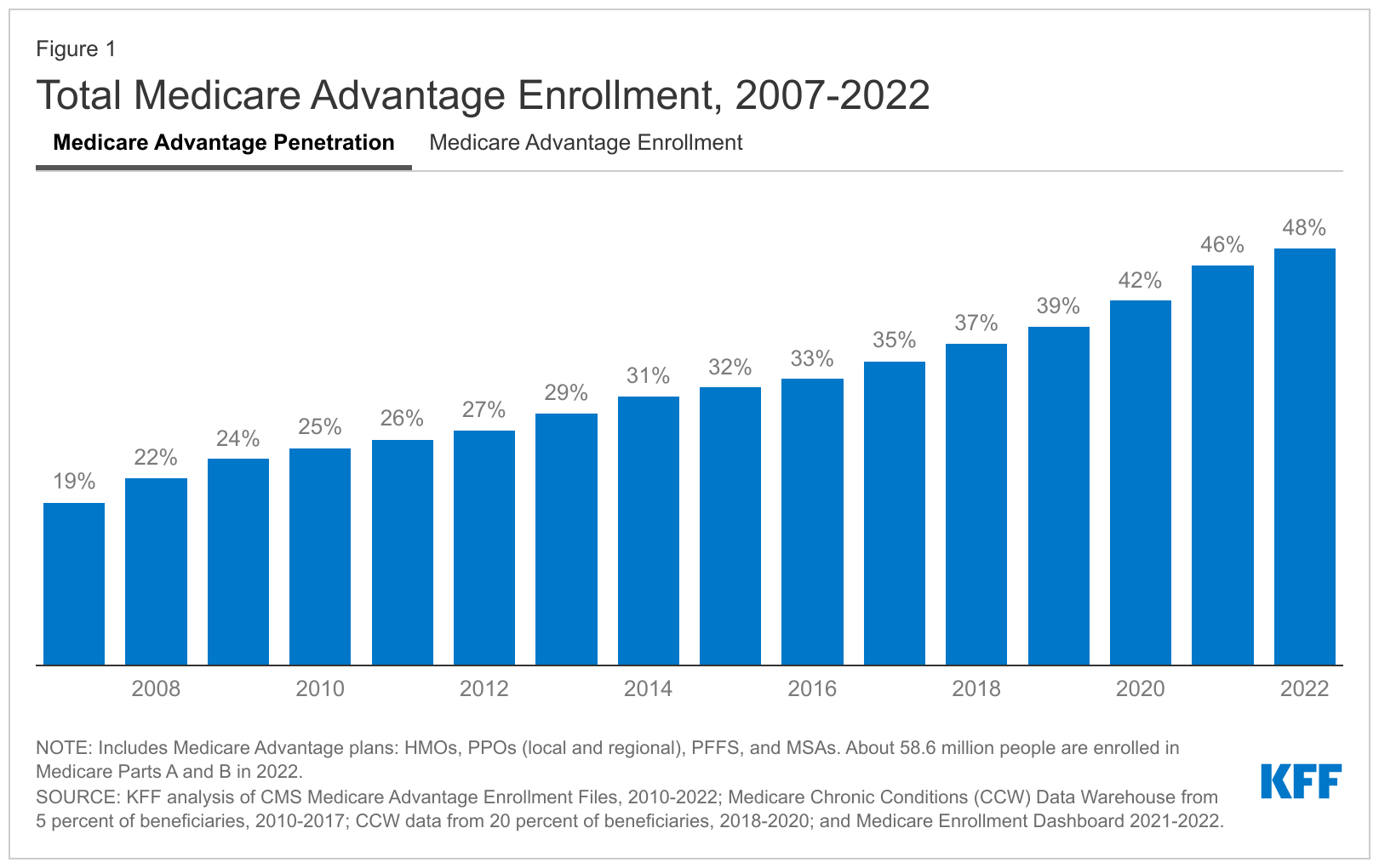
Right now, it's around 50-50 between the two models:
You can quote either option at your leisure here:



Now...let's look at comparing the different plans within each category.
This is pretty easy these days.
Really, two plans dominate new enrollment:

There's also a high deductible G plan that comes up occasionally for people who really just want catastrophic coverage.
Here's a snap shot right from Medicare but we'll dig in a bit:
| Medigap Benefit | Plan F | Plan G | Plan N |
|---|---|---|---|
| Part A coinsurance & hospital costs (extra 365 days) | 100% | 100% | 100% |
| Part B coinsurance / copay | 100% | 100% after Part B deductible | Copays apply [1] |
| Blood (first 3 pints) | 100% | 100% | 100% |
| Part A hospice coinsurance / copay | 100% | 100% | 100% |
| Skilled nursing facility coinsurance | 100% | 100% | 100% |
| Part A deductible | 100% | 100% | 100% |
| Part B deductible | Covered | Not covered | Not covered |
| Part B Excess charges [2] | Covered | Covered | Not covered |
| Foreign travel emergency (to plan limits) | 80% | 80% | 80% |
| Out-of-pocket limit | N/A | N/A | N/A |
With the G plan, it covers the main holes in Medicare except for the Part B deductible ($283/year in 2025 for doctor visits and out-patient)
You can see there are two differences between the G and N plan:
Here's the important piece that no one talks about:
This makes it super easy to compare.
Once you decide on a plan level (such as G plan), let us run a quote across available carriers in your area to help you compare options based on cost and other factors.
Why?
The Birthday Rule! One more peculiarity of California (which we're super excited about) is that we can switch to same or lesser benefit Medicare supplement around our birthday. More on this below but it means we're not locked in!
The best pricing can really differ by area. There's no one carrier that dominates (although 2-3 are very strong) and the best priced option will generally change as we age. We quote all the major carriers side by side for you!
One other note...a few carriers will offer a New to Medicare discount of $25/month for the first year with the G plan. This goes away but most people generally never re-shop the market!
It's common for people to stay with initial plan but we encourage regular (annual) review of your options. The benefits and networks are identical between carriers and this is why people tend to really like their plan.
That's a function of Medicare Supplements...not the carrier that is offering it.
We just need date of birth and zip code to quote all the main carriers for a given plan.
In fact, there are still millions of people on the old F plan and probably paying around $700/year+ more for almost the exact same plan as the G plan (just the Part B deductible difference).
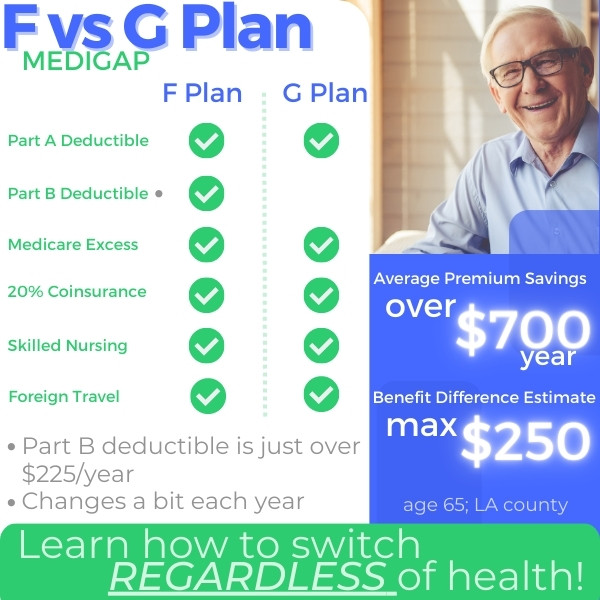
This makes comparing Supplements pretty easy.
Advantage plans...not so much.
Unlike Medigap plans which are standardized (benefits and networks are identical across plan type), the Advantage plans are all over the place and there can be many options in a given area!
So...how on Earth do we compare these plans?
Lean on us for more nuanced comparisons but here's our triple threat baseline:

First, we really want to focus on the Star Rating that Medicare provides. This is a measurement of current/prior members and what they feel about the plan.
It's on a 1-5 Star scale.
Remember...with Advantage plans, there are inherently more restrictions put on who you can see (the network) and what care is allowed.
The Star rating is our best indication at how much hassle we'll deal with along these lines from insiders!
Think of the reviews in Amazon but for referrals and access to doctors.
That makes it really easy since many plans will have 3 or less Stars.
In a given area, Advantage plan core benefits are pretty commoditized which means they'll start to look the same in terms of premium, deductible, and even Out of Pocket Max...which bring ups our next section.
Out-of-Pocket Max
This is a critical piece of the puzzle with Advantage plans. If we have a really bad year with lots of medical expenses, when does it go 100% to the carrier for covered benefits, in-network?
That's the Max!
All those copays and percentages add up till you hit this number, Jan - Dec.
This number can really fluctuate between areas. In more populous areas like Los Angeles, you can see OOPs in the few hundreds per year which is attractive.
In other areas, like the Bay Area up north, greater San Diego county, and more rural areas, it's not surprising to find OOPs of a few $1000's.
That's a totally different calculation now if we know we're going to have big health bills and lots of them.
The Medicare Supplement with its higher monthly premium but lower backend starts to pencil out better in this case.
So...don't JUST focus on monthly premium but consider that Out-of-Pocket Max.
One key note...there are plans out there designed for people with Medi-cal (State run program you qualify for based on income generally).
They will have very large OOPs but that's because Medi-cal will absorb most of the out-of-pocket for these people if you're "Full Dual"...both Medicare and Medi-cal.
This gets confusing so we're happy to help you walk through this situation.
Okay...so we have:
We're going to skip right over premium and deductibles since those start to become pretty similar in a given area and just right to the heart of what drives most decisions these days.
Networks!
Which plans work with your chosen doctors and hospitals.
We help 1000's of Californians compare their Advantage plans and recently, this takes center stage.
In some areas, it's a real issue and we have to look at PPO Advantage plans or even Medicare Supplements.
That's a huge deal!
Certain counties in the Northern Bay Area are also becoming an issue. Expect more of this over the next few years as everyone scrambles to contain costs.
We've seen some carriers face challenges with costs recently, which can affect plan options—it's why checking current details is key.
In our quoting system, we can load in your doctors and hospitals to filter the plans that work with them and you can even run your own quotes but here's the real deal.
We usually have to spend around an hour each account to chase down if the doctors are really working with a given plan. We're calling medical groups, offices, scouring websites, etc.
There's no cost for this assistance so lean on us. The online directories can be okay but usually not complete.
Many doctors will bill under medical groups or different locations (sometimes participating only at one location).
Just send us your doctors/hospitals and their location. We'll narrow down the options accordingly.
That's how we get our baseline for comparing Advantage plans:
Fun fun fun.
We're happy to do this at no cost to you and with no obligation!
Now...that's just the baseline. From there we have to look at all the bells and whistles that people are after these days, especially in areas where it's super competitive like greater Los Angeles.
Look...let's see if we can hit the benchmarks of our Triple Threat (it is a health plan after all) but also squeeze every little penny out of the plan to our favor.
Right???
To run the quote, we just need date of birth, zip code, doctors/location, and medications/dosages.
Speaking of which...
Traditional Medicare does not cover out-patient RX. This is different from medications administered in a facility.
Think CVS, Walgreens, Costco, etc.
It used to be a big issue until Part D came on scene in 2006.
Part D is a stand-alone RX plan you purchase from a private carrier. It's not technically part of Medicare.
Most Advantage plans already include a Part D (It's the "PD" in MAPD). With Medicare Supplements, you'll need to purchase a separate Part D if you want RX coverage.
IMPORTANT NOTE: If you don't purchase a Part D plan when eligible, there will be a penalty of 1% per month that grows for as long as you go without (assuming you don't have equal RX coverage like through an employer plan).
This addition applies for the life of the policy!
So...wait 10 months...you'll pay 10% more forever.
Part D plans are pretty easy to shop for and this is how we do it for clients.
Email us date of birth, zip code, medication/dosages. We'll run all the major carriers and sort by "Total Estimated Cost".
Super easy way to compare. That and the Star Rating basically makes the decision for you.
We'll run a quote based on best value and send it over to you.
Now...what's going on in the market and a word of warning going forward.
There have been really inexpensive plans (a few dollars per month) in the last few years as carriers have tried to gobble up market share.
Keep in mind that you can change plans or enroll during Open Enrollment at the end of every year.
With the Inflation Reduction Act, caps were put on how much a person would have to pay on the backend with medication costs of $2000/year.
This is great but there's a cost to it and we expect that Part D rates might jump significantly in 2026 and beyond.
Again, we'll still apply the same quoting strategy above but budget for it now! Premiums might range from $40-50/month or more, but this can vary by plan, area, and year—always check current rates.
Alright...let's turn to practical matters now.
If Chapters 1-3 helped you get a handle on Medicare, would you do us a quick favor?
We're going to make this super easy and streamlined knowing that you can always reach out to us with any specific questions (and there WILL be questions!).
Here are the broad strokes:
That's it! Not so bad, right??
Let's break these down.
First, there's Traditional or "Original" Medicare
This is the government program and there's Part A and B.
Most people become "eligible" when they turn 65 or leave employer coverage after age 65.
There are other less-common triggers so reach out to us with your situation if different.
Let's go with turning 65 since that's the bulk of enrollments.
Let's say our 65th birthday is May 29th (a fantastic B-day by the way!!).
There's a weird wrinkle for people born on the 1st of the month where they can actually be eligible one month earlier. So...May 1st b-day would be eligible April 1st.
In our May 1st example, we can enroll in Part A and Part B Medicare as early as Feb 1st (3 months prior to when we're eligible).
It will take a few weeks for them to process the request and you'll get confirmation of your Part A and B effective dates as well as your MBI# (Medicare Beneficiary ID number).
Thank goodness they no longer print Social Security numbers all over the place!
We need the Part A and B effective and the MBI# for the next step!
Once we have Part A and B active, we can fill in the gaps of traditional Medicare.
Let us run the quotes for you!
Just need:
For Medicare Supplements, we'll run the quotes across the major carriers and send over the online app for the best value. It will look something like this but based on your age and zip code:

Remember, the benefits and networks are IDENTICAL!
We also re-run these quotes in out-years to make sure you're still on the best priced option.
For Advantage plans, we'll run the full quote and the online application is available directly through the quote we send over!
There's ZERO cost for our assistance. The rates are the best available by law and we can help throughout the year.
If you went the Medicare Supplement route, we'll send over a separate quote based on your medications and you can enroll right through the quote!
We'll sort by Total Estimated Cost to take into account medications and dosages.
That's it!
In our May 29th example (eligible May 1st), we need to submit by end of April worst case to get the May 1st start date but earlier is better.
Reach out with any and all questions!
Let's now dive into specific topics that are near and dear to every Californian's heart.
Now we're finally talking.
How much is everything going to cost me out-the-door for Medicare and the various add-on plans (Supplements, Advantage, or Part D).
You'll get lots of information from various sources on specific Medicare plans.
We want the good, the bad, and the ugly. With a little less ugly if possible.
We're going to break down what you can expect in terms of the total cost with Medicare along the most common avenues.
More importantly, we're going to look at ways to save and ways you want to avoid.
Let's get started along these lines:
We are happy to run you exact rates and options at no cost or obligation to you!
We're just trying to show you how to approach the budget question.
Let's get started. Our goal is provide an easy to understand guide to Medicare that you might want to share with friends!
It's California after all!
First, Uncle Sam (Medicare) has its cost!
There are two parts:
For most people, they will need to pay for Part B and the amount depends on your recent income.
This amount can go much higher (up to over $600/month) with higher income and even lower as income drops.
You'll get your amount when you "opt-in" for Part B through Social Security.
That's cost #1 and it applies regardless of Medicare supplement OR Advantage plan.
That's where the real cost difference is. Let's go there.
Supplements and Advantage plans fill in the basic "gaps" of Medicare:
You can think of Advantage plans as HMO options (since most are HMO in
nature) and Supplements (also called "Medigap") as PPO options.
The key takeaway in terms of cost:
Here's the nitty gritty:
This works well in the greater Los Angeles area but not so much in San Diego or the Bay Area.
So...what about the cost?
If we're looking only at monthly cost:
So...now we're at (Part B monthly to Medicare + our add-on:
A few important caveats with ALL cost estimates.
So this, this is a rough sketch! Again, we're happy
to do this with more precision for you!:

One final piece to calculate our damage!
Traditional Medicare nor the new supplements cover medication.
For this, we need a separate Part D plan with a private carrier.
Part D plans can run from around $10-15 up to $50/month on average (varies by area!)
Most people find a high-rated plan in 2025 at around $20 so let's go with that.
Now, we have the grand total monthly (based on an estimated out-of-pocket of $800):
Keep in mind that there can be out-of-pocket for medication costs which aren't included. This is just a rough estimate of our monthly.
Assume maybe another $100 (5 meds at $20/month) added to either cost depending on your medication needs. This is pretty high if your meds are basically generic in nature.
The Advantage plan might be quite a bit lower in a year with low to average medical expenses. Also, your Part B may be lower or higher based on income.
There's no cap to the 20% coinsurance with Medicare so we need some protection there!
We're seeing bills in the millions lately for hospitals which unfortunately, is way too common now.
You don't want to be responsible for $100K of a $500K bill!
There is one big consideration if you're eligible for Medi-Cal.
Estimates suggest around 20-30% of Medicare beneficiaries in California may be dual eligible, but check your own eligibility.
This means they're eligible for Medicare and Medi-cal.
This can bring down the costs for Part B (via income) and even out-of-pocket expenses with Advantage plans.
Check with the local county to see what you're eligible for and quote accordingly! Let us know at help@calhealth.net and we can run the plans that take advantage of the eligibility (called "medi medi").
Chronic illnesses also have specific Advantage plans that may bring down the cost.
So...how do we compare the plans taking into account our new cost information?
First, find out what your Part B cost (based on prior income) from Social Security
Keep in mind this number may go down in later years if your income is dropping (retirement, etc)
Advantage plans are low/no premium which seems so wonderful in the flyers.
We show why this works when the max-out-of-pocket (your total exposure) is under $1000 versus supplements.
This is the wrong time to take the bet that you won't have healthcare costs:
That's the age piece but healthcare costs are not your friend in this decision either:
So...if you have Advantage plans with max's under $1000, it pencils
out better.
Otherwise, we have to consider our true out-of-pocket (monthly AND cost
sharing when sick or hurt).
It's easy for these comparisons to seem complex. We're happy to run this comparison for you and there's no cost for our assistance for either Advantage OR Medigap plans.
Alright...anything we can do to bring down these costs?
Advantage plans can bring down the costs if you're in an area with low max-out-of-pockets and you're in pretty good health or have Medi-Cal.
Keep in mind that you'll trade the size of provider networks and how care is managed.
Within the supplement side, you can look at the high deductible G plan or the N plan to bring costs down.
For basic coverage, there's the simple A plan to cover the 20% coinsurance.
The G plan and G plan high deductible are popular choices since they cover Medicare Excess (more below). The N plan is the next most popular option but it does not cover Excess so we'll want to make sure our doctors accept Medicare. There are also copays for office visits and ER visits.
With these options, we can bring down the Medigap cost by quite a bit.
By how much you say??
Medicare plan costs are based on area and age.
Run your personalized quote here:
The Advantage plans have a separate quote based on your doctor and
RX info so they can be personalized.
We're happy to analyze your options just like we did above to find the "sweet spots" for Advantage versus Supplements/Part D.
Advantage may be great in your area or they may not be so great (high max out of pocket).
We'll let you know and quote the costs for the following as a benchmark:
Just run your quote above and we'll send this all to you. There's no cost for our assistance and check out our Google reviews!
We work with the strongest California Advantage and Medigap carriers that contract with private hospitals/doctors.
Now...how many lattes pay for one supplement?
Alright...let's look at those who need to work a few more years to afford all this.
This is a big question that comes up as more people are choosing (forced???) to work beyond age 65 in California.
Here's the skinny. Part A is generally automatically enrolled when you take Social Security. Part B is "opt-in" as we described.
Most people on a legit employer plan do not take Part B (why take on the extra cost if your employer is covering you??).
You basically stay on the employer plan until you're ready to retire as long as it's financially advantageous to you!
We can help compare these options as it gets more complicated.
Speaking of complicated...
First, there's a lot of confusion out there around the size of the company and how that affects your options.
Technically, a company under 20 employees is secondary to Medicare. This means that Medicare pays first and then the company picks up.
So...the concern is that...if you don't get Medicare Part B, you'll be on the hook for expenses outside of inpatient hospital (think doctors, labs, out-patient, etc).
In some States, that may be true but in California, we have never seen a major carrier NOT (we know...it's a double negative!!) pay claims for employees over age 65 who don't have Part B.
That's just practical experience from 100's of small businesses we've enrolled and managed over the years.
Keep in mind, the carrier is charging full pop for someone on Part A Medicare either way so they BETTER pay for the expenses typically tied to Part B.
What about the spouse and/or other dependents.
Some people will keep their employer plan so that their spouse (usually younger) continues to have coverage.
If not eligible for Medicare, we can always get them enrolled in Covered Ca especially if they only have a short time till Medicare starts for them.
Also, they may have a Cobra 18 month window to piecemeal the employer coverage just for them if you cancel for the primary enrollee.
For some companies, that can be extended another 18 months for a Cal-Cobra extension. This usually gets people over to Medicare for the spouse as well.
We're happy to run both the Medicare quotes and the Covered Ca quotes as needed.
Advantage plans would be much cheaper (but HMO).
Let's turn our attention to the biggest issue these days when choosing plans.
This depends completely on the type of plan we go with.
Medicare supplements are easy.
You can see any doctor or hospital that accepts Medicare...anywhere in the country!
You refer yourself out. Just make an appointment, verify they work with Medicare, and go!
We'll talk about the doctors that take Medicare but charge more than what's allowed (called Excess) in a later section.
This flexibility and choice is probably the primary reason that people on Supplements love their plans. Seriously love them.
There are giant medical groups who are deciding not to work with any Advantage plans and it's becoming an issue.
How do we address this?
Luckily, our Advantage quoting system will take into account doctors and hospitals so make sure to send us their info (name and city).
We can then sort and filter by this information and the quote you receive will tell you exactly which plans work with which doctors.
If you don't have specific doctors, focus on what hospital you want access to and we can anchor to that for filtering.
In populous areas (greater LA, etc), we have lots of options and can generally find a plan that will work with your doctors.
The online directories aren't always straightforward and we spend quite a bit of time on the phone with doctor offices, carriers, and medical groups cross referencing to get an answer.
It's literally half of our jobs when quoting these days but going it alone is a recipe for frustration down the line.
Again, no cost for our assistance!
If you can't afford a supplement and live in a tougher area in terms of networks, we can look at PPO versions of Advantage plans.
There are a few that are pretty solid and we lean on those when the HMOs just don't have the same reach.
These plans have one set of benefits in-network and another (less rich) set for out-of-network.
We're seeing the PPO Advantage plans grow in popularity but definitely use the Star Rating as a litmus test.
If existing members are not finding them to be as flexible as promised in terms of networks, it will show in this rating! We'll flag this when running quotes for you if PPOs are your goal.
What if we don't like our plans?
This gets tricky so we'll hit the highlights but reach out to us with your particular situation.
We're going to break it up into separate sections:
First, the best kind...guaranteed windows.
You have certain periods of time where you can enroll, dis-enroll, or change regardless of health.
These are the main triggers:
For most people, this occurs when you turn 65. The 1st of the month that you turn 65 in generally.
Let's say our 65th birthday is May 29th again.
You generally have a seven month window to enroll in Medicare Part A and/or B around the month of May.
This initial window is really important because if you miss it, you may have to wait till you can sign up again. There can also be penalties for delaying enrollment.
If we miss the initial window, we'll have to wait for the next Jan-March period and coverage would start on April 1st. Don't delay!
The penalty goes forever!
Remember...it's the Part B that drives everything.
The other big category of people is those who continue working and have employer coverage past age 65.
Usually, they'll already have Part A from signing up for Social Security but hold off on Part B because their employer coverage is better (cheaper for rich benefits).
It needs to be equivalent to what Part B covers in order to be "creditable" and avoid penalties or delays from not taking Part B at age 65.
We have an 8 month window after loss of employer coverage to enroll in Part A and/or B.
One note...Cobra may not be available if you're eligible for Medicare! Be careful of this as many people find out the hard way.
Those two categories make up almost all the Medicare enrollments we see. There are other less common triggers out there!
People under age 65 may qualify for Medicare if permanently disabled (official status with Social Security).
Again, the new Part B starts the clock.
Reach out to us with your particular situation. The key is that we need Part A and B effective in order to enroll in either an Advantage or Supplement plan (Part D only requires Part A).
Next up...the Advantage and Part D options.
We'll break this up into two sections:
The initial period to enroll in an Advantage plan or Part D (same rules for both) is triggered by a new Part B enrollment generally.
It's the same 7 month window for original Medicare:
So...if we get our Part B when turning 65 (May 29th example), we have Feb - Aug to enroll. If we enroll from Feb-April, we'll get a May 1 eff date.
Afterwards, we'll get the 1st of the month after enrollment.
Just get it down prior to loss of coverage so you're all set!
After loss of employer coverage, you have the same 8 month window to enroll.
So this all aligns with traditional Medicare (Part A and B).
Changing is really different for Advantage and Part D.
There's an open enrollment period at the end of each year where you can enroll, change, or dis-enroll from Oct 15th through December 7th.
There's another window from Jan - March the following year where you can change or disenroll once.
This is the "do-over" for people who don't like the Advantage plan they picked. The do-over does not apply to Part D. Only Advantage plans!
There are all kinds of weird little rules that may allow you to change outside of these big windows:
Again, reach out to us if you want to change outside open enrollment and we'll see what's available.
Lots of smaller rules!
Let's turn our attention to Medicare Supplements.
So, we have the same rules for (7 month window) for new enrollments around a new Part B.
We also have the 8 month window after losing creditable employer coverage.
After that...it gets interesting.
You can apply for a Medicare Supplement (as long as Part A and B are active) ANYTIME during the year.
Outside the initial windows above though, approval is subject to health. They can decline coverage essentially!
A few notes on this.
Sometimes, carriers might offer "underwriting holidays" where they will re-open regardless of health and this usually occurs around the end of the year. We can't count on this but it happens.
If we're on an existing Medicare Supplement, we can change to the same or lesser benefit plan around our birthday regardless of health! More on this below.
If you try an Advantage plan for the first time and don't like it, we may be able to get a Medicare Supplement without underwriting (health questions) within 12 months of the initial enrollment.
Again...check with us but we can usually get people approved with pretty standard health issues regardless.
So...the net net:
One more key...we can always go to an Advantage plan.
Going the other way (from Advantage to Supplement) is trickier outside open enrollment windows.
We have to get approved by the supplement carrier first (usually during Jan - March) and then dis-enroll from the Advantage afterwards.
It happens all the time and we'll coordinate the whole process for you!
This is a lot of information. Your head may be spinning. Reach out to us with any questions!
There's no cost for our assistance.
Let's zero in on that one piece above...the Birthday Rule!
This is fantastic. As an advocate for Seniors, we love bringing power back to the consumer.
Here's the deal.
In California, a Medicare Supplement member can change to a similar or lesser plan around their birthday...regardless of health! Guaranteed Issue.
Before this law, if your health changed, you were stuck with the carrier you originally enrolled with.
There are millions of people overpaying for Medicare Supplements and they don't even know it.
Let us run the quotes for you across the major carriers knowing that around our birthday, we can easily change.
First...the Birthday Rule.
Many people are familiar with enrolling in Medicare originally and how they could pick any Medigap plan regardless of health.
This is usually at age 65 or coming off of group coverage (with other triggers like moving, involuntarily losing coverage, etc).
There's a window of 7 months during which you can choose a plan, and they can't decline you based on health.
People can still qualify based on health, as the underwriting isn't too bad. We'll try this way and see what the chosen carrier comes back with.
But...worst case, in California, a person around their birthday can:
The golden ticket!
This is available for people aged 65 and older in California.
So...what plans can we change to?
There's a range of currently available Medigap plans:

We'll rank the popular plans in order of decreasing value, although you should reach out to us with your situation at help@calhealth.net :
Now...there are wrinkles to this now. Some carriers have brought out different versions of the F and G plan (extra, etc) that might affect rankings.
There are also high deductible versions of the G and F plans.
Check with us about your current plan and the one you're interested in and we'll double-check if the switch is subject to the birthday rule at help@calhealth.net
Let's really zero in on the timeframe since it's pretty important.
Here's the official rule.
You need to apply for the Medigap plan:
This is directly from Shield's Guaranteed Issue Guide (very handy). They are very flexible and other carriers may differ on timing so check with us first.
So, let's really break this out to make it clear (that's what we do!!)
Let's say your birthday is May 15th.
As for the effective date, it will be the 1st of the month following app submittal but no earlier than May 1st in our situation even if we submit March 1st.
We make the "completed" part easy by having online apps available for the major carriers:

We can also take paper apps and help with any questions so there's nothing that will mess up the processing. More on quoting and enrolling below.
Let's now look at the most common situations.
This is the big one. So many people are still on the old F plan which was discontinued to new enrollees effective 2020.

So, worst case...a net savings of around $500/year is pretty common.
Otherwise, the other benefits are identical!!
This is just found money and we're happy to help people find it.
Many individuals still remain on the F plan! Switching to a G plan can result in significant annual savings and our job is to find these savings!
Again, we should try right away and see if we qualify. Otherwise, we have the birthday rule in our back pocket since the F to G is a true lesser benefit (just the doctor deductible of roughly $283+).
There's another angle though even if you want to keep the F plan (or G plan, etc).
Let's say you have the F plan and want to keep it.
Run the quote across the carriers!
It's not atypical to see monthly rate spreads up to $100+/month at higher ages for the exact same plan.
And there are lots of people on those higher rates.
Our estimate is that tens of thousands of Californians may be paying more for the exact same plan.
Year after year...paying $100's/year for the exact same plan and network.
We have a passion in helping people move to the lowest priced plan with quality carriers and our secret weapon??
The birthday rule.
Again, we try with a standard app and health questions but if there's an issue, we wait for the birthday and we pounce!
Let's look at even more extreme situations.
Like the "closed" F plan, some people are still on the old J and I plans.
In 2010, Part D was created in Medicare which finally brought medication benefits to the senior market.
The I and J were closed for new enrollees but many people are still on the J plan. It makes up roughly 3% of the senior market still!
The pricing difference is even more extreme between the J and say the
G plan with a Part D.
Let us know what you're paying now for your J, I, or F plan plus your date of birth and zip code. We'll run the numbers and do a complete comparison for you at zero cost!
We mentioned how the I and J plan covered medications. How does Part D work with the birthday rule?
Part D is a whole separate beast from Medigap coverage.
The new Medigap plans do not cover mediation so we'll need a Part D plan. If you're on the F plan, you probably already have a Part D so this may not be an issue.
What if you don't have Part D or you still have the I or J plan?
This may be a two-step process then if we use the birthday rule.
Worst case, we can enroll during open enrollment at the end of each year
(Oct 15 - Dec 7th) for a Jan 1st eff date.
If we have to use the birthday rule to enroll in Medigap, it may go like
this:
There could be a gap on the medication piece if you don't have a Part D already.
Again, if you're using the birthday rule to downgrade from a say an F to a G (very common), you probably already have a Part D and that can continue. It's separate from the Medigap choice.
If, however, you're newly enrolling in Medigap (only had traditional Medicare) or are downgrading from the J or I plan, you may have to wait till Jan 1st for Part D to kick in.
Reach out to us and we can help you!
Alright...that's the why. Let's look at the how!
This is easy. And running a quote is free to you with no obligation!
You can quote the major carriers here:
A few notes.
Since the benefits are standardized (A G plan is a G plan, regardless of carriers),
As for pricing, it's generally been a few strong carriers that shine on pricing.
This can vary by area and age so it's really important to run your personalized quote here!
Reach out to us with any questions to compare.
Alright, we find a plan we like that will save us $100's per year (very common...seriously).
Now what?
This is our favorite part.
With our online system (no cost for you to use), you can submit online applications to the major carriers.

Even Part D quotes and enrollment are available.
When you run the quote, we'll send over access to the online apps which takes the old process of about 45 minutes and drops it down to roughly 15 minutes.
If you need help and want someone to walk you through it, no worries. Let us know a good time at help@calhealth.net and we're there to help.
Let's turn our attention to a situation that can affect roughly 30% of the Medicare market!
Roughly a 3rd of California Medicare members are "medi medi", meaning they have both Medicare and Medi-cal.
We've covered eligibility for Medicare above. Medi-cal is usually based on income and it's completely separate from Medicare.
That being said, they can work together for people who are eligible for both (called "medi medi" or full dual).
This can offer additional help and options for people in California with Medicare.
You can still get a Medicare supplement but if you're qualifying for medi-cal based on income, that monthly premium is likely to be too expensive.
It starts around $150/month for the G plan in 2025 which is out of the range for most people dual eligibles.
So...that usually points to Advantage plans and there are unique carve-out plans for full duals.
Two quick notes...
The Out of Pocket Max for Medi Medi plans (called D-SNPs) tends to be much higher but that's because Medi-cal (California's version of medicaid) will pick up most deductibles, maxes, and out of pocket costs.
To offset this, there can be richer benefits elsewhere in the plan around:
Again, medi-cal offsets the higher out-of-pocket max IF you're dual eligible.
So...make sure you're eligible for full Medi-cal since there are different levels. Reach out to your local Medi-cal office by phone or in-person. Get Medi-Cal contact info here.
Another perk for Medi-Medi individuals revolves around changing or enrolling plans.
The first of the month after enrollment/change will be your effective date.
We're happy to run quotes for you across these plans and we really want to focus on doctors/hospitals that you want access to.
Just need your date of birth, zip code, doctors/hospitals, and medications/dosages. Let us know your Full Dual status so we can quote accordingly at help@calhealth.net
Let's turn to everyone's favorite topic. Part B premium.
As we mentioned, Part A is generally free to most people (well not free...you've paid into your whole life through payroll taxes).
The number can be higher or lower based on income 2 years back (tax filing in 2023 for this year).
It's the IRMAA (Income Related Monthly Adjusted Amount). It also applies to Part D (RX plan) premiums as well!
Here's the 2025 data (will go up each year).

These are 2025 rates as announced; IRMAA amounts are subject to annual updates by CMS and may change.
If your income has decreased since the prior tax return (2 years back) due to life events (e.g., retirement, spouse's death), you can request an IRMAA reconsideration by filing Form SSA-44 with the Social Security Administration.
We highly recommend people do this as many get approved and it's found money!
If you don't take Part B, there's no coverage for services outside of overnight (inpatient) hospital which is a huge exposure.
Don't risk it. Also, there's a penalty for enrolling in Part B AFTER your eligibility window (discussed up above).
You may also have to wait to get back on if you missed the initial window.
Payment for Part B can occur monthly through Social Security deductions or quarterly with a standard bill.
The number will reset each January based on COLA and cost of living increases primarily.
Is there anything we can really do about Part B premiums?? It's almost $2k/year after all.
Hello Giveback Plans!!
Don't take our word for it...
In 2025, approximately 32% of Medicare Advantage plans offer a Medicare Part B premium reduction, also known as a Part B giveback benefit, according to data from the Kaiser Family Foundation (KFF). This is a significant increase from 2024, when 19% of Medicare Advantage plans provided this benefit.
So...that's quite a jump and the number of people picking this option keeps growing as well.
Why and what are they?
Part B Giveback plans are Advantage plans that will reduce your Part B premium deduction.
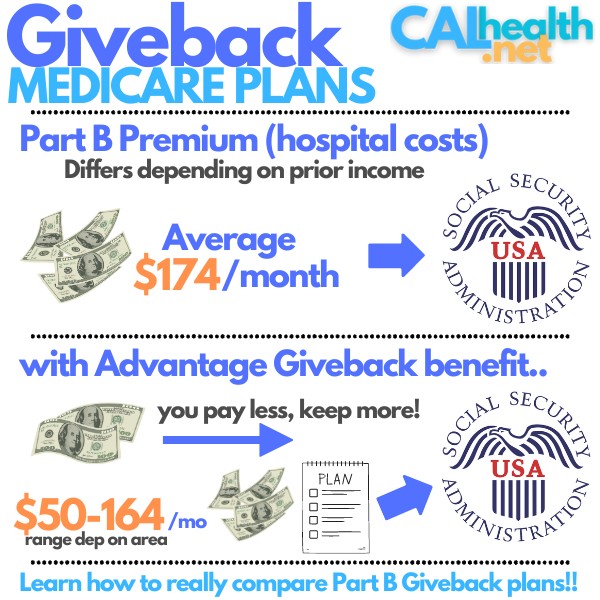
If the average Part B premium is $202/month, that's quite a bit of real money that you can end up with.
The plans generally offer different amounts back with the highest we've seen around $150/month depending on the area.
That's $1800/year or almost $2K of real money.
It's a big deal especially for certain people:
For some people, the Part B premium giveback is the only basis they have for picking a plan.
Again, this is roughly 30% of the market especially since you can change plans end of each year anyway if health changes longer term.
We can run the quote for these options in your area with the Part B Giveback benefits specified at help@calhealth.net. Just let us know this is your main priority so we quote accordingly.
You can also run your own quote below and make sure to select "Part B Giveback" as the filter.

What do we give up in order to get this benefit?
Usually, the Giveback plans will have slightly smaller networks or less rich benefits elsewhere (zero in on the max out of pocket!). Again, this plan tends to attract people who are better health, less picky on network, or who have coverage elsewhere in addition to Medicare (think Veterans).
Let's turn our attention to a question that comes up on the Supplement side of things.
With traditional Medicare (Part A and B) and/or supplements, there's an item called Excess.
It matters because the F and G Medigap plans cover "Excess" but the other plans do not.
How important is this? It usually comes up when comparing the N (does not cover Excess) and G plan these days.
It's a good question and we've reached out everywhere to get a good sense of how many doctors charge Excess.
As we mentioned above, roughly 99% of California doctors work with Medicare. Nationwide, it's estimated that 2-5% of doctors charge more than the standard Medicare rate.
California is probably at the higher end of this only because it's so expensive to be a doctor in the State!
With 1000's of Medicare clients over the years, we haven't seen an issue with Excess to date but most people pick the G plan so that would protect them from it.
The only thing we don't like about plans which exclude Excess coverage (like the N plan) is that there's no cap to the 15%.
15% of $4K for a surgeon is quite a bit out of pocket!
It's not just doctor visits but all the other things doctors do where costs can be higher.
This answer isn't very satisfying to us but it's the best info that's out there on the subject. Believe us...we've tried to dial it in better!
All things being equal, the G plan addresses Excess and that's by far the most popular medigap plan.
As the N grows in popularity, maybe we'll get better guidance.
Let's turn to a simple answer for a change.
We have people on Covered California who don't want to leave. They're getting a really rich subsidy (sometimes zero premium) and very rich versions of the silver plan (Silver 94 is richer than the platinum plan).
No!! Well technically, they can keep Covered Ca but with no subsidy or richer silver plans.
Even if you are only eligible for the Part A side of things, Covered Ca no longer makes sense.
The pricing/benefit value will be so much better with Medicare with an Advantage plan or Supplement and Part D.
The cost for 65 year old on Covered Ca without the subsidy is through the roof!
We come across some people who are not eligible for Part A and B (usually new to the U.S.) but otherwise, Medicare will be the better value and at 65, that's going to kick in for most people.
It's common for people to contact us about getting Covered Ca for their parents coming from other countries who are not eligible for Medicare. As long as we have legitimate legal status in the U.S., we can usually get them subsidies and richer plans (based on income).
If you were on a PPO or EPO, Medicare Supplements probably make the most sense. Of course, these are completely different markets so we need to understand the new world of Medicare (which you're doing right now with this guide!)
As we mentioned above, monthly cost is a big deciding factor and we're happy to walk through your situation and preferences at help@calhealth.net or 800-320-6269.
Let's go the other direction now.
We've talked quite a bit about Medicare at age 65 and older.
Many of the same timing windows exist for these people around getting a new Part B so don't wait too long.
Medicare Advantage plans allow you to enroll during Open Enrollment (Oct 15 - Dec 7th) each year regardless in case you miss the original window.
For Medicare Supplements, it's a little tricky in that the pricing for pre-65 is so much higher.
Generally 3-5 times higher than age 65 and over.
That makes it difficult if we're after a PPO type of option where you can see any Medicare doctor.
There are PPO Advantage plans which are closer to supplements but not as flexible as the real thing.
If income is stretched, it may be the best of both worlds though if we're under age 65 with Medicare.
California is different in that it requires that some Medigap plans be available to eligible people under age 65. That's good news!
Again, happy to run all these numbers and quotes for you!
Another carve out.
We get these calls all the time.
Someone has Tricare, VA, etc and they're eligible for Medicare.
There are different ways many veterans look at this in terms of strategy:
So...it really comes down to how happy they are with the current availability of VA, Tricare, etc care!
Also, there's quite a bit of interest in dental, vision, OTC, and other options that can be available in Advantage.
Occasionally, Veterans will look at the MA plans (with no "PD" for prescriptions) since RX is handled well by their veteran healthcare.
So...there's lots to talk about generally as each situation is completely different (area and VA facilities really drive the decision).
Rarely, do we see supplements come into play and this is generally when a person wants access to Nationwide networks or they split time in an area without strong VA facilities.
This is more costly but having access to MD Anderson or Cedar-Sinai, etc can be a big motivating factor for some veterans. Especially with more extensive health care needs.
This may drive the decision more and more. Reach out to us with your situation!
So...if we can boil this all down, how do we really get to the heart of what many Medicare members really want...
What a good strategy for saving with Medicare?
We'll break down into 5 key areas:
Let's get started!
Saving with Social Security itself
Don't just sleep on your Social Security or Medicare costs and assume they're a done deal.
Sure, Social Security will eventually catch up but why spend the extra money while waiting.
Of course, there are strategies around when to take Social Security (which is separate from Medicare!) and then there's the Part B Giveback plans.
You can quote these options in the section above. Happy to help with any questions on these!
We have lots of videos around ways to save on Social Security so check them out here.
Once we've dialed in savings with Social Security, then it's the various options around Medicare!
Saving with Advantage plans
This is trickier. We covered a lot up above but here are the real drivers we see after helping 1000's of Californians.
The last last one is really important. Many people will just stay on the same plan because it feels overwhelming with all the options.
Let us do the hard work for you so at least you can see what's out there. We'll note if there are options that are interesting versus your current plan and narrow it down so it's much easier to compare.
Otherwise, use the Triple Threat above to compare and reach out with any questions from there!
Saving with Medicare Supplement plans
This is super easy because the benefits and networks are standardized at the federal level.
It's zero cost for our assistance! We'll quote all the major carriers and plans for you. Don't be in the "Half a Billion Club"!
Saving with Part D
This is also pretty easy.
This takes into account both monthly premium and estimated out of pocket expense!
In the quote, if a medication isn't covered OR is a brand name, the system will show you options to reduce your costs!
It's a fantastic tool. Use it! Also, check out "GoodRX" online to make sure your pharmacy isn't overcharging you.
Also, we come across a lot of people are way overpaying for their Part D plan. They signed up years ago and never really looked back. We're talking $10's to $100's of premium extra each month.
The carrier for your medigap plan is rarely the same as that for your Part D. Certain carriers are just more competitive and focused on the Part D market.
Shop this annually! You can run your quotes here anytime at
no cost to you:
Finally...
Saving with out of pocket expenses
This is beyond the scope of our day to day activity but we LOVE to help people understand this.
It didn't make sense to us since he had an Advantage plan with a big carrier in the other State and he got the surgery pre-approved. Went through all the right channels.
The carrier said it wasn't their responsibility because the doctor was out of network. He was going to pay the $6000 (on limited income...medi medi at the time).
We see this all the time. The point is this...
Make sure to review all healthcare charges! If a bill appears incorrect or unclear, contact the provider and/or the carrier.
If their answer doesn't seem right, call again. It's advisable these days to stay diligent on the billing side.
Unfortunately, we have to be our own advocate these days.
Okay...that's a wrap.
This is a lot of information and if you stayed with us all the way through... Thank you! You're in a much better place to navigate the world of Medicare but we can only touch on the main points.
Everyone's situation is different.
Reach out to us.
Most importantly...be well! And...welcome to Medicare!
Dennis Jarvis is a licensed California broker (#0C65199) and founder of Goodacre Insurance Services. Over the past 25 years, he has helped thousands of Californians through Medicare, Covered California, and Employer benefits selection - all at no cost to the consumer.
Need Personal Help? Schedule a Free Call with No Obligation:
Important Medicare Disclaimers: