Annuity Shop and Compare - What is an Annuity in Simple Terms
What is an Annuity in Simple Terms
Annuity 101: What are they? How to SAFELY invest your money as a senior! #financialfreedom - Watch on YouTube
There's so much confusion around Annuities but they're actually pretty simple when you strip off all the jargon plus bells and whistles.
We're going to start at the 40,000 foot view and make our way down into the weeds so you can make a much better decision.
Annuities are exploding in popularity right now which is a combination of two massive trends which isn't about to end:
- Demographic shift with many millions of people entering retirement
- Risk and flux in other markets (stocks, bonds, etc) that's unlikely to change
We'll compare annuities versus other options as well but first, our credentials for telling the straight truth:
Here's what we'll cover:
- Annuities explained in simple terms
- Annuities compared to other
options
- Types of annuities
- The "Golden Rule" of Annuities
- The
three questions to ask
- How to shop annuities correctly
Let's get started!
Annuities explained in simple terms
The concept goes back to Roman times.
At its heart:
An annuity is a way to create an income stream from an asset!
It's usually money in lump sum or in a series of payments but either way, we're having our money make money for us.
The most common sources of this money:
- Inheritance
- Sale of real estate or businesses
- Excess cash
from income
- Transfer from other assets such as 401K, IRAs, CDs, Savings or even other Annuities
These days, we see quite a bit of annuity activity from #1, 2, and 4.
With inflation, any money you have sitting around is losing around 3-4% a year (if we're not looking at the double "shadow inflation" estimates or the debasement of currency (printing more dollars to pay debt).
Let's say you have $100K of money suddenly. Maybe you inherited it (the boomers hold the most wealth of any demographic).
What do you with the $100K? There are only so many options.
Let's first address that question!
Annuities compared to other options
The most common things can do with the $100K (besides spend it!) are:
- Stocks
- Bonds
- CDS and other fixed income options
- Buy a
business
- Buy real estate
- Annuities
There are pros and cons to each and really, annuities shouldn't make up 100% of your assets anyway!
It's really a question of safety (for your money) versus potential gain.
Stocks can increase more but they can also go down and nearing retirement, having a big drop early can be brutal longer term.
This is called the "sequence of events" problem. It's hard to make up for a 10-20% drop and stocks are currently at an all-time high (in terms of dollar terms, percentage terms, and concentration in a few stocks).
Bonds are generally less volatile but tell that to the Treasury market the last few years! The value of bonds inversely correspond to interest rates and much smarter minds than us try to figure that out.
- Debt loads
- Strength of the dollar
- Political flux both
domestically and worldwide
- Demographics (which drives debt loads)
- Economic cycles
Bonds generate income BUT the underlying vehicle can also lose value IF interest rates go down.
Like I said...smarter minds and people much closer to the system.
Then there's CDs and other fixed income options.
The problem is that the rate they pay is low, locked in, and interest is actually taxed annually!
That's pretty easy to beat with annuities.
Finally, there's starting a business or buying real estate.
We'll leave it to your discretion as to whether you want to take on a new business at retirement but the real estate piece is fascinating.
In our State, California, the cards continue to stack up against landlords.
Just check out the new AB2493 passed in 2025.
Essentially, you have to take the first applicant that meets basic requirements (provided in writing in advance) now. Even if you don't think they're the best applicant!
Add this to all the other crazy rules and it's relegating being a landlord to very large companies (think BlackRock) with a league of attorneys at their call.
It's a shame really since many retirees used this option to fund retirement.
That leaves annuities.
Annuities were designed as a middle ground.
- Protect the principle from loss ($100K in our example)
- Create income stream from that principle that's better than fixed markets (CB)
For retirees, it's the Holy Grail. Steady income or gain
without loss of principle.
Let's now try to simplify an increasingly complex marketplace.
Types of annuities
There are 100's of products out there from dozen of legitimate carriers with dozens of "options".
Really, it breaks down pretty simply!
- Fixed income annuities such as MYGAs that pay a fixed % for a fixed
period of time (think CD)
- Indexed annuities that protect principle
but allow more potential upside tied to another market (like S&P stock
index)
- RYLAs which allow more potential upside but also cap the
loss of principle
- Variable annuities - not our favorite...you can use principle and not have the full gain on upside plus expensive (fees)

We really only focus on MYGAs, and Indexed annuities since they speak to the whole reason to consider annuities versus other options!
Protection of principle with income stream (either fixed or tied to another index).
There are now "hybrid" annuities out there that will pay you a minimum fixed OR a share of an index (S&P); whichever is more.
We really like this approach and expect it to take over the market especially if there's any flux in the stock market.
There's been massive growth in the "riskier" side of the annuity market over the past few years since the stock market has been on a tear (remember...all time highs!).
We expect this to flip (remember..Buffet's in record cash) at some point and the annuity market to tilt towards MYGAs (fixed, safe) and Hybrids (lower fixed with some potential gain).
This is it!
Everything else is about rates, riders, and different ways to skin a cat!
Here's the Golden Rule of shopping annuities that puts you in power.
The "Golden Rule" of annuities
No...it's not that the insurance company has all the Gold but...
Annuity are a commodity.
Simply put, the carriers probably make the same margin give or take regardless of which type of annuity you pick.
- If this annuity has a higher interest rate, it probably caps it in
other ways
- An upfront bonus will offset this along the life of the
annuity
- Riders can add extra payout but the cost of them will probably offset this
There's no way to game the system because if the margin is less on a given product, don't expect it to be around after the duration!
How can we use that to our advantage as shoppers?
First, you need to see all the legitimate options in a given market
(more on that below).
Many "brokers" will pitch ONE carrier
or plan. This is a terrible way to shop for annuities!
From our Medicare experience, we see the huge range of pricing for the G plan which is standardized (same benefits, networks, etc) across the carriers.
Millions of senior are over paying and the Advantage plans are no different.
Next up, we need to really ask what we're hoping to do with the annuity
Let's get to the three questions.
The three questions to ask before shopping annuities
The Chinese have a saying...."Well begun is half done".
Start well and really dial in on these questions:
- How much money to contribute
- How long a duration
- How consistent do you need the income to be
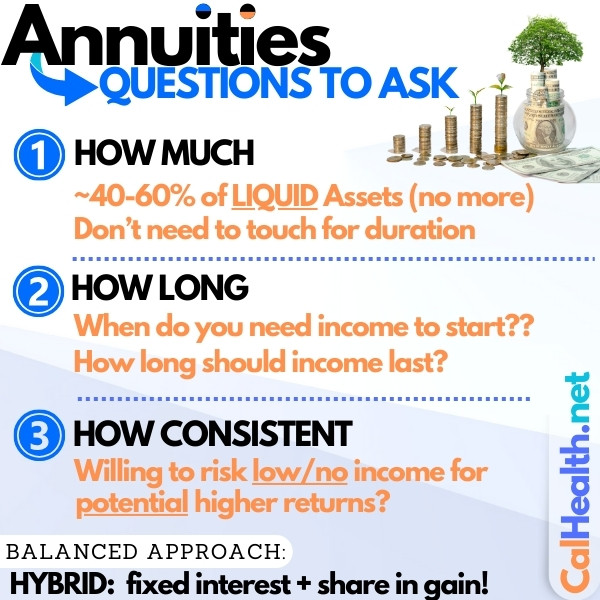
A quick explanation!
How much money to contribute
Take a look at all your liquid assets. These are assets that are cash or can readily be converted to cash..quickly.
Stocks. Bonds, Retirement accounts. CDs, etc (but with penalties if not at duration).
Of that money, the current good housekeeping % to put in annuities is between 40-60%.
Meaning, we don't want all our eggs in one basket. We come across people who don't plan to ever touch the annuity as they don't need it for income to meet expenses.
So...start to think about what you need to live on and what can safely be put to work.
With annuities, there are generally durations that they are somewhat locked up. Let's turn to that.
How long a duration
Two pieces to this question.
How long are you comfortable not touching the money ($100K in our example) outside of 10% annually or payment.
There are surrender charges that go down with time so we don't want to take the money out of the annuity. Plan for emergencies!
You can either fund annuities with a single lumpsum OR a series of payments.
Secondly, how long do you want the income stream to exist?
A fixed period of time? 10 years? Should the income start right away or after a period of time?
There are even options to receive payments for life! Even life of a person and spouse.
In this usage, it's like reverse life insurance. Insurance for your income!
This is where you can get so many different options but if you address what your ideal use, it really narrows the options.
The trade-off to longer and faster payments is the rate they'll pay you!
Finally, there's the question of risk tolerance.
How consistent do you need the income to be
Some people really don't do well with fluctuating values (stocks, bonds, etc).
They panic and sell low while FOMOing (fear of missing out) and buy high. You know who you are! "Hello, my name is Dennis and I'm a terrible market timer".
- MYGAs wil pay less interest but it's locked in! No worrying about daily (hourly???) changes
- Indexed annuities will offer the potential to share in market gains and if the market goes down over a period, protect you at zero loss.
As we mentioned, RYLAs and Variable annuities have potential principle loss although RYLAs cap the downside (but also the upside).
From our experience, MYGAs and Indexed annuities are the purer form of the product with the new Hybrids being a new middle ground between the two.
Once we have our answers, how to we actually see options and rates.
Thought you would never ask!
How to shop annuities correctly
Beware any broker or carrier that's pitching one product from one carrier.
You really need to shop the major carriers and products side by side.
We believe this so much that we provided a tool where you can access 100's of products from dozens of the strongest carriers directly AND instantly (no waiting for emailed sales pitch) here:

This is the Holy Grail of annuity shopping. Follow the steps and reach out with any questions. There's no cost for our assistance.
Accumulation versus Income?
- Accumulation means you just want to grow your asset ($100K in our
example) over a period of time. You don't need the money right now.
- Income means you want to generate income from your asset either to pay immediately or later one.
Once you're in the "right" market (MYGAs versus Indexed, etc), focus on our Triple Threat for Annuity Selection.
- Guaranteed Rate
- Low Historical Rate
- Carrier Rating
Guaranteed rate is the contractual amount you know will come in. With MYGAs, this is easy! It's listed right there.
Watch out for people pitching 10 year fantastic returns on Indexed and other annuities. We just went through one of the greatest stock market grown of ALL TIME pumped up by trillions of liquidity from the Covid aftermath.
The odds of continuing or reproducing those results are...well....small.
Instead, focus on the lowest historical return to have a better sense of what to expect from Indexed, etc annuities.
You'll have access to that right through the link above or we can track down any info for you.
Finally, carrier rating matters. Annuities are not FDIC insured but each State has a fund to cover losses if the carrier goes under.
That's rare but a carrier can experience changes in their results that affect how they pay out in future years.
Many annuities (outside of MYGAs) can adjust returns/options at different durations.
Aim for A rating or better in the quote tool!
The stronger the carrier, the more stable you can expect the returns on average.
That's it! Hopefully, we make the marketplace so much easier. More importantly, you'll see what it's like to work with us for selecting annuities. No sale push.
We just answer questions all day and if we're helpful, hope you work with us since there's no cost for our assistance.
Call 800-320-6269
Email:
help@calhealth.net
Pick a
time to talk
here
Chat
online here