Annuity Shop and Compare - Why Annuities Right Now?
Why Annuities RIGHT Now!
Annuity 101: What are they? How to SAFELY invest your money as a senior! #financialfreedom - Watch on YouTube
We're going to walk through the landscape of ways to put money to work for you with a focus on the very peculiar period of time we find ourselves in.
We've already described what annuities are in simple terms and even compared the two primary types but this is more about other options.
How to compare Annuities to:
- Stocks and Mutual Funds
- Bonds
- CD's and other fixed income options
- Real Estate
Especially in context of where we are and the next 10 years (albeit without a crystal ball).
First, our credentials for telling it like it is (and what some sales pitch so common with annuities):
This is what we'll cover:
- Quick intro to Annuities versus other options
- Annuities versus stocks and mutual funds
- Annuities versus bonds
- Annuities versus CDs and fixed income
- Annuities versus real estate
- Current landscape for annuities
Barring starting or buying a business, these are the traditional alternatives.
We'll look at why annuities are especially attractive now and strategies to even maximize where we are and the current state of flux out there!
Let's get started.
Quick intro to Annuities versus other options
We first need to sketch out the annuity product and we'll focus on the two major types.
- MYGAs - fixed return for a defined period of time (think CDs but higher rates)
- Indexed Annuities - returns tied to an index like the S&P

There key selling points with these annuities which are important to our discussion below:
- There are many no-fee options
- Your principle is protected...you cannot lose it
- Gains are tax deferred
We'll see how this really contrasts with the other options.
There are 100's of products in this space so that throws many people but our review comparing MYGAs and Indexed annuities really breaks it all down to these two key products which can tailor in many ways.
Now...let's look at the alternatives and then explore options for the Goldilock's zone with annuities.
Annuities versus stocks and mutual funds
Despite the sales pitch, annuities are not really designed to compete with stocks or mutual funds.
Yes, there are indexed annuities that will share in gains from various stock exchanges while protecting from loss of principle.
You can think of indexed annuities as "discount" stock exposure.
You're protected from losses but your gains will be capped by different mechanisms:
- Participation rates: you get a % of the gain when the underlying index increases over intervals
- Caps: your gains are capped at certain levels
- Spreads: an amount that is reduced from total gains
The participation rate option is very popular right now.
For example, if the S&P index goes up 10% over an interval (usually one year) and the participation rate for a given annuity is 60%, you would get 6% (60% of 10%). This does not include dividends.
Sure, that's lower than the 10% but what if the market decreases 10%? You get 0% (or some minimum amount depending on the plan).
This is really for people who are risk adverse and can't stomach down years (more on why that's an issue in the future below).
To be very conservative, assume 5-7% annual return from indexed funds over a long enough duration (5 years+).
Again, the issue is where stocks stand as of this writing.
We've never seen such an explosive gain or run-up in stocks since...well... ever. Even before the great depression, the internet bust of 2000, or the great financial crisis.
Those were all bubbles (tech, housing, etc). This is being called the "everything bubble" since it's driven by liquidity or debt itself and the "Magnificent 7" are the tip of that spear.
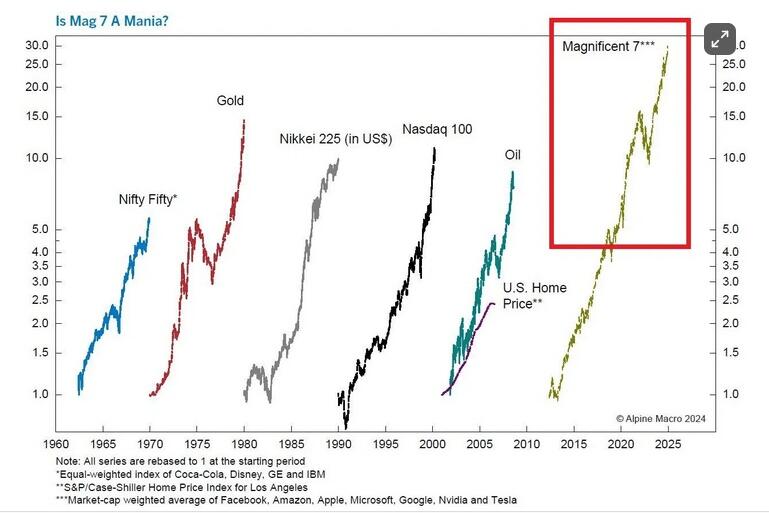
Even Buffet has record amounts of his funds in cash right now and his whole business is around investing in well-priced assets.
He's sitting this one out for now.
With stocks, what's the probability at our current height that the next 10 years reproduce gains or even mirror historical averages?
The results after the busts above for the following 10 years are not encouraging.
Mutual Funds are just more expensive vehicles to capture stock gains compared to ETFs (which still have fees) and Mutual Fund will ding you annually for gains!
Annuity gains are tax deferred till you actually take funds in the form of withdrawals or income payments.
So that's 60% of the now defunct 60/40 plan spread that's dominated past few decades.
What about the 40% (bonds)?
Annuities versus bonds
Bonds have increased in value for decades now. It's the longest bull run in bonds ever. Till Covid hit.
Once they pumped Trillions (with a T) into the economy, inflation reflexively (too many dollars chasing too few goods) took off.
CPI and PPI just showed this trend is proving to be more difficult than originally expected.
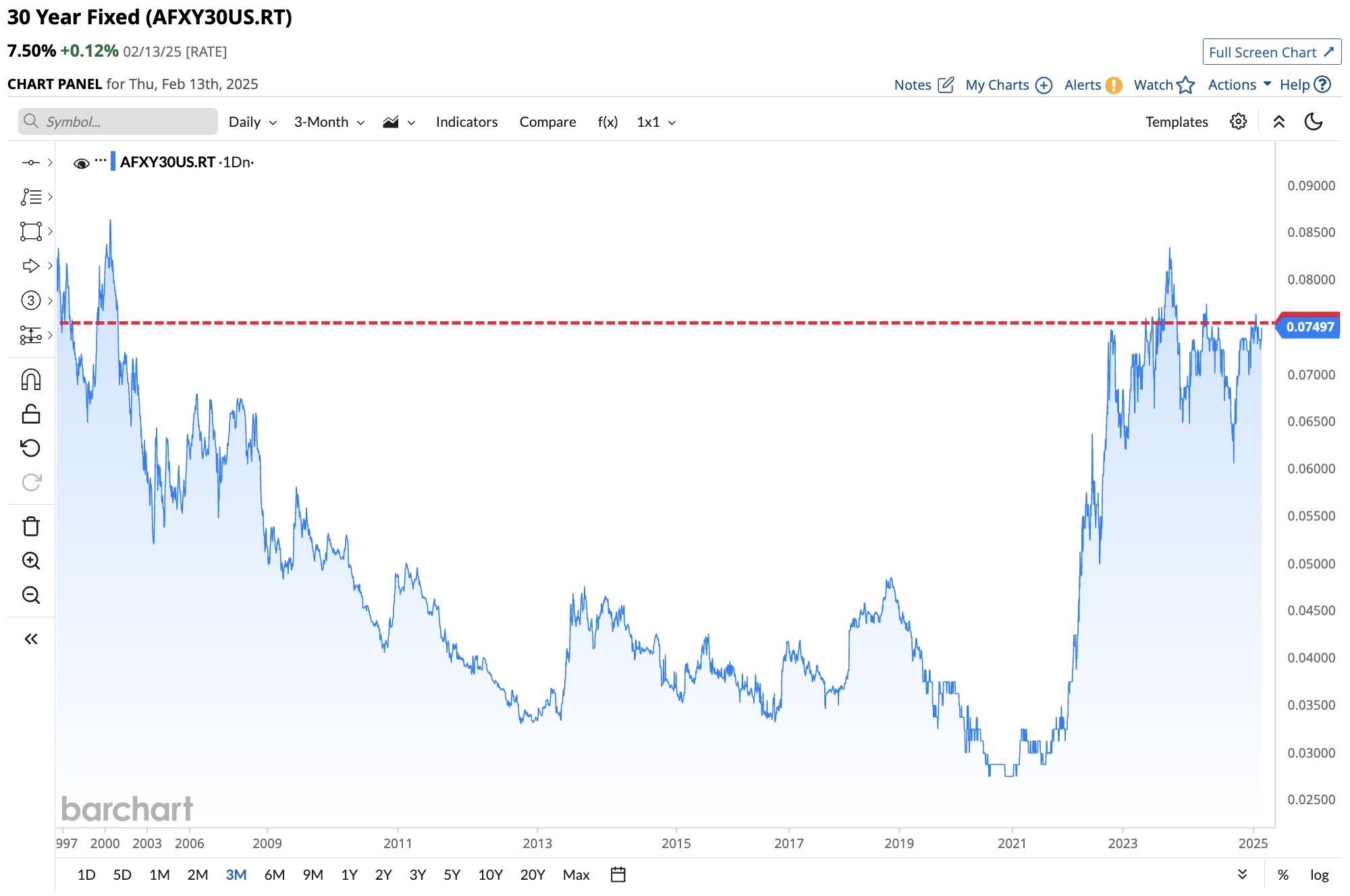
Bonds are generally treated as a source of income since they are debt instruments after all but the principle can also lose value!
If inflation continues and the 10 year treasury rate keeps rising, the existing bonds will lose value.
It used to be rather tame in terms of moves in this market but not lately!
I'm sitting on some TLT which is down 10% in roughly 6 months. That's shouldn't be a thing in such a staid "safe" market.
Here's the issue...the US debt load just keeps exploding higher with interest paid now above $1T annually.
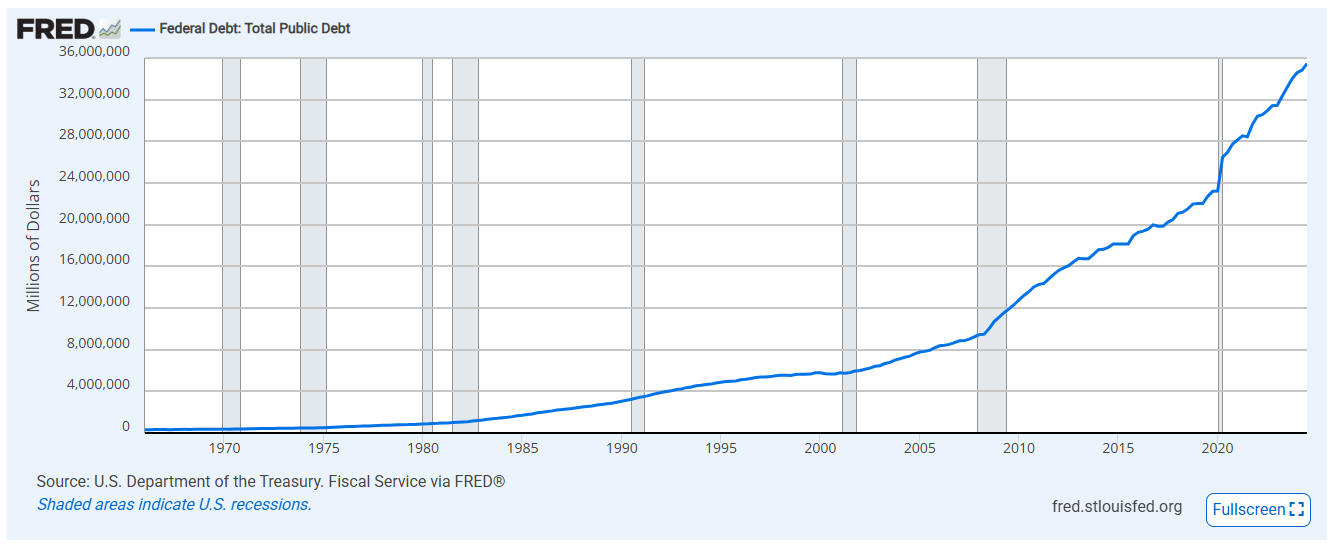
This isn't sustainable and you do see them cutting Medicare, Defense, and Social Security?
Didn't think so.
This is hard on bonds since the Treasury will have to compensate buyers for the higher debtload with...increasing rates.
Which drives interest payments and resulting debt!
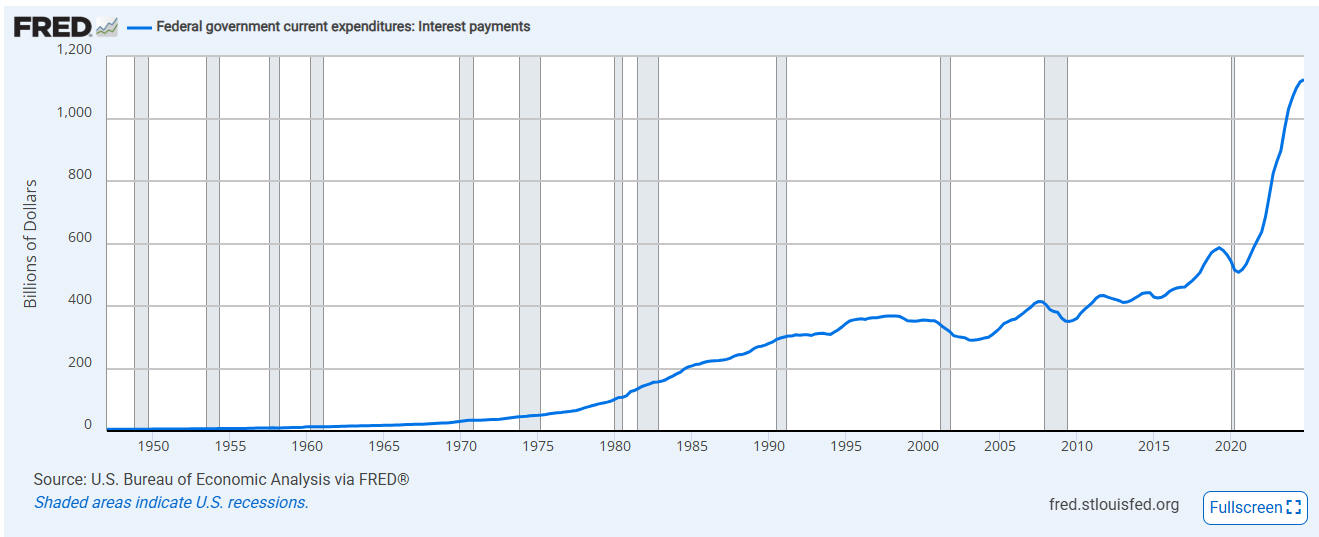
All of this debt is ultimately a result of demographics with a shrinking and aging population.
To maintain a certain level of GDP, they're using debt to paper over reduced spending as our population ages/shrinks.
Same is happening with all major countries which just creates more supply of debt.
Purchasing bonds in that scenario is...difficult.
We can lock MYGA annuities at rates higher than traditional bonds right now and not lose any principle.
Not sure how to justify the "40%" bond side of the equation now that we're out of the 4 decade bull run.
Also, bond dividend payments are taxed when received!
Even worse is the fixed income space.
Annuities versus CDs and fixed income
CD's have all the restrictions but with less payout versus annuities!
You lock in your money for a period of time and get less interest than with a competitive MYGA.
Really hard to justify this market at all and this speaks to why MYGAs and annuities have exploded over the past decade.
- Current 5 year CDs are running around 4%
- Current 5 year MYGAs are running around 5.85%
Almost 2% difference!
No fees. No tax on gains (only payouts). You can defer income or even generate lifetime income.
More importantly, that's a 46% increase in the rate they pay you!
Again, not sure how CDs are even around anymore other than people really don't understand annuities or they've been put off by people negatively speaking about them (who happen to sell competing products!!).
CDs and MYGAs are both driven by "cost of money" so 10 year treasury, inflation, etc.
They will rise and fall accordingly at the time of purchase but then lock in for a duration.
Let's look at another common alternative.
Annuities versus real estate
It's been a pillar of investment gains for decades now and largely followed the expansion of our population resulting from the baby boom.
Buy real estate and play landlord while it goes up an average 10% a year.
That process may have hit a rough patch unless you're BlackRock.
First, the market is driven by interest rates which is driven by the same issues that may plague bonds up above.
Higher rates (from higher debt and inflation) crush the market. Florida, Austin, and other "hot spots" are seeing prices plummet.
Didn't we do this in 2006-2008??
The Covid windfall of $Trillions caused a mini-bubble in real estate and all bubbles pop.
This is the whole "sequence of events" issue where you purchase an asset that happens to occur right before a drop.
The gains for any market separated by just a few years for starting can be so different.
For example, if you bought stock in 2000 before 3 down years, your portfolio may never recover if you're trying to take out 4% year to live off of (the strategy that dominated retirement professionals for decades now).
Whereas, you bought the same stocks (same amount of principle) in 1995, you would have been much better off.
The gains were in the beginning!
A 10% drop requires a much higher following gain to get even!
The other issue stems around the current "business" of being a landlord.
We're in California and the cards are stacked against small landlords and only Aces have been pulled lately.
The newest addition is law AB 2493.
As of January 1, 2025, California's AB 2493 requires landlords to process applications in the order they are received. This means that landlords must approve the first applicant who meets their screening criteria.
The criteria must be provided in writing to the applicants.
You no longer get to pick who moves into YOUR property!
Expect this to continue as housing costs explode with the underlying debt and debasement of currency continuing.
Small landlords will be the scapegoat. Coming to a theatre near you!
Current landscape for annuities
Interest rates are high now (relatively speaking...check out 10 year treasury) which drives how much annuity companies can pay you.
It directly affects the MYGA payout percentages but also the indexed annuities.
Index annuities create income and then use all or a portion to buy call options on the underlying index (S&P for example).
The more the interest (which is driven by the 10 year treasury benchmark), the more call options they can buy.
If you just want safe income or gain, then MYGAs are the way to go and you can stagger them.
- Buy 25% 3 year
- Buy 25% 4 year
- Buy 25% 5 year
- Buy 25% 6 year
The durations can be different but the idea is to layer different durations and then roll over the proceeds as the newer one expire.
You also get higher rates for longer durations but you have more flexibility as you're only a year or so from being to take out money with no penalty.
A better approach if you're okay with more flux (but no loss of principle) is a LIC or Layered Income Cake.
- Buy 25% MYGA 3 year
- Buy 25% Indexed 4 year
- Buy 25% MYGA 5 year
- Buy 25% Indexed 6 year
You have steady income from the MYGAs and then hopefully share gains with the indexed annuities. You can even adjust what index these annuities are tied to from Gold to Magnificent 7.
This way, if we have a crash and inflation crashes, we have MYGA protection. If miraculously, the market keeps marching forward, we have exposure via the Indexed annuity starting in year 2.
Once you hit year 7, you can roll over the first MYGA into another one or even to an index annuity if the market had crashed by then.
You adjust accordingly but all your bases are covered in the meantime.
This reduces the FOMO that causes people to make bad decisions.
Looking at back-tested annuities showing double-digit gains (Mag 7, Nasdaq, etc) is tricky based on everything we've talked about above.
The last 5 years are an extreme example of market activity. Remember, they pumped Trillions into the liquidity system, most of which went to risk asset speculation (hello Crypto!).
Either way, we have a strategy and we can just keep rolling into higher and better positioned new annuities as they come to term.
Another option is the hybrid annuity. For example, we just got notification from an A rated carrier of 4% floor or 55% S&P share, whichever is higher.
This is equivalent to what we did below but much simpler (just one purchase/plan).
I'm personally going to add this to my annuity portfolio as a nice way to straddle our current situation.
Remember the Golden Rule of Annuities.

They're commodities so focus on the contractual obligation (MYGAs) or the worst case performance (Indexed annuities) to be conservative.
You can quote 100's of options (that's the only way to shop annuities) here fast, free, and immediately:

Reach out to us with any questions as we're here to help. Be well!
We just answer questions all day and if we're helpful, hope you work with us since there's no cost for our assistance.
Call 800-320-6269
Email:
help@calhealth.net
Pick a
time to talk
here
Chat
online here