California Medicare Options - What percentage of California seniors have medigap

What Percentage of Californians have Medigap
Medicare Advantage vs Supplements (Medigap): The SHOCKING Difference! California Guide - Watch on YouTube
It's an interesting question and the answer breaks down very clearly across different demographics as we'll see below.
This partially speaks to where Advantage plans do well (and where they don't!)
We can also break down which Medigap plans Californians are choosing and most importantly...why!
We've looked at how some people are paying much more than they should for the exact same coverage and how to use the Birthday rule to remedy this situation but let's zero in on the numbers, please.
First, our credentials:
We'll break down the stats this way:
- What percentage of Californians have Medigap
- What percentage of Californians have Part A and B
- What percentage of Californians have Advantage plans
- Who generally buys medigap plans
- What are the most popular medigap plans in California
- How to quote medigap plans in California
Let's get started. Get your protractors ready! Just kidding...but we're both old enough to know what those are!
What percentage of Californians have Medigap
California's share is actually higher than the national average.
About 34% of Medicare beneficiaries in California have a medigap plan.
So...roughly a 1/3rd of Medicare eligible people.
This number has slowly been trending down over the past decade with the advent of Advantage plans (mostly HMO versions on the market - see Medigap versus Advantage plans).
With increasing cost pressures, this trend will likely continue but Medigap will probably end up at about 25% or 1/4 of the market by the end of the decade with current trajectories.
What about people who just have traditional Medicare by itself?
What percentage of Californians have Part A and B
This is generally called FFS or Fee for Service. It's the opposite of HMO in that the coverage pays out when covered services are rendered by a Medicare doctor.
We know it as Part A (hospital) and/or Part B (doctor). The second part is optional.
So...how many people just have Part A and/or Part B?
In 2021, Advantage plans made up about 1/2 of the market. If Medigap made up roughly 1/3rd, then those without Advantage or Medigap were approximately 17%.
Keep in mind that Medigap plans are in the FFS bucket since medigap plans just wrap around traditional Medicare.
We've looked at the risk of just having Medicare here.
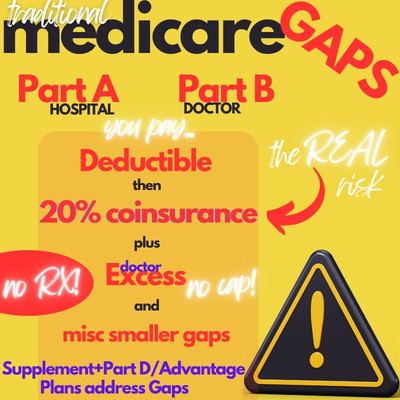
The real risk is the 20% coinsurance which has no cap!
65+ is the wrong time to try your luck with "I never go to the doctor...I'm fine".
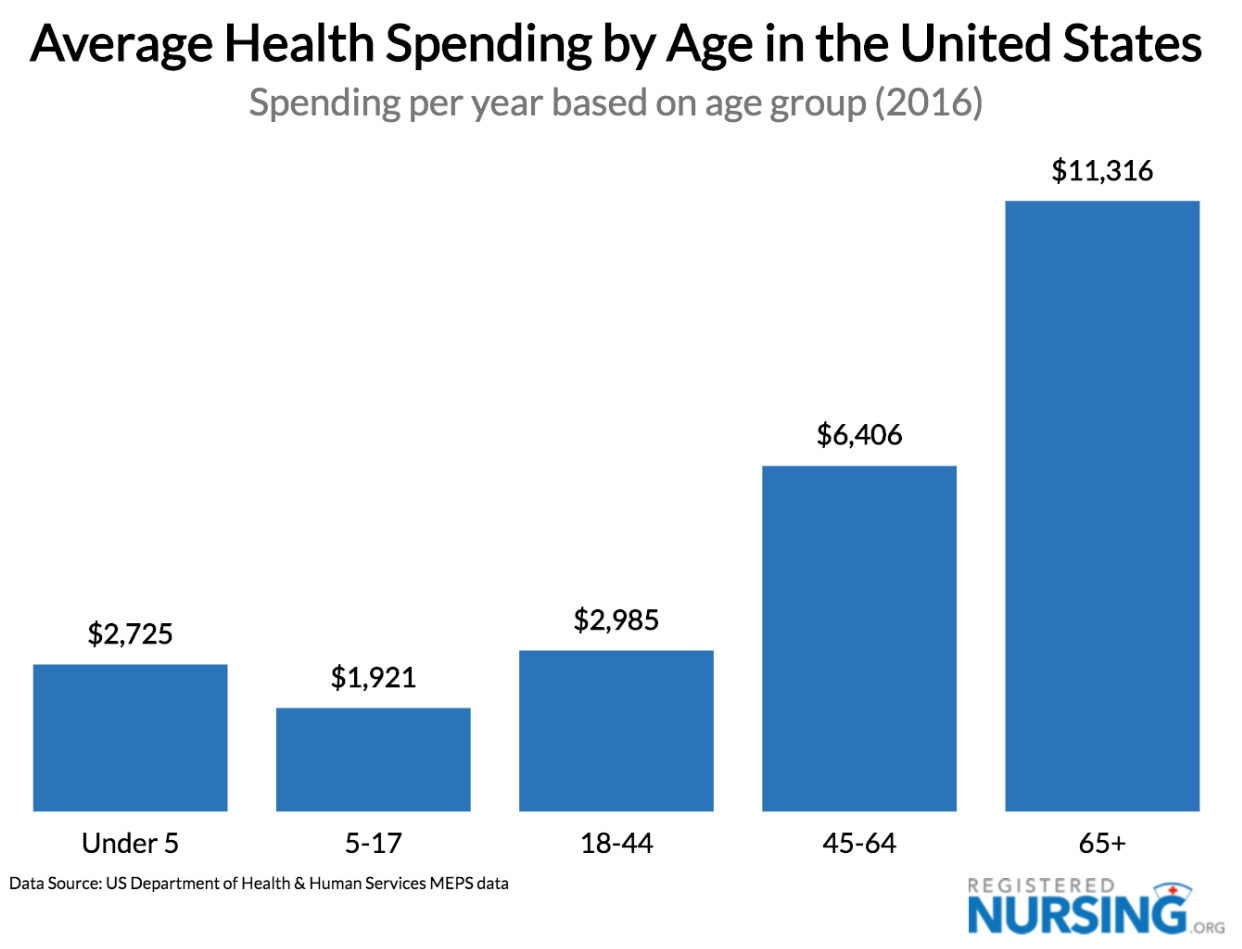
At least get an Advantage plan with no premium to cap the backend or even an A
medigap plan which caps the 20%.
We're seeing bills of $500K+ now for heart and cancer from clients. The heart one is unfortunately very common these days!
Speaking of Advantage plans.
What percentage of Californians have Advantage plans
Advantage plans just keep growing in the market:
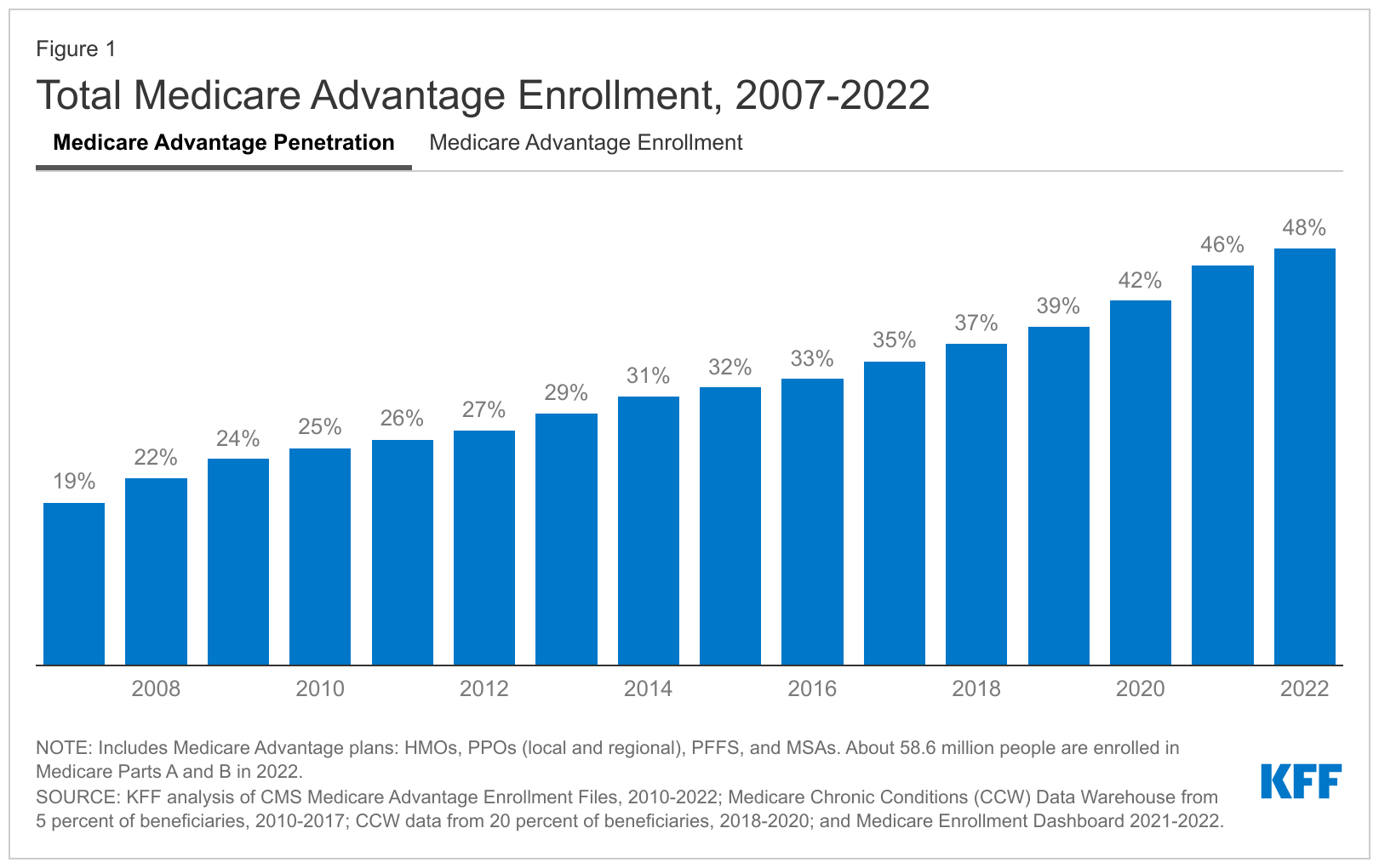
This is a response to cost pressures in California, where everything just keeps
going up.
Many Advantage plans have zero monthly cost but you have to really look at the full picture.
They also have Out of pocket maxes that can run from $800 to $3-4K per year!
Get to the heart of how to compare Advantage and Medigap or How to compare Advantage plans.
It comes down to the "Triple Threat":

Interestingly, this really drives who is buying medigap plans.
Who generally buys medigap plans
There are some key divides between the average person on an Advantage versus a Medigap plan.
First is the Urban-Rural split.
Goodness!
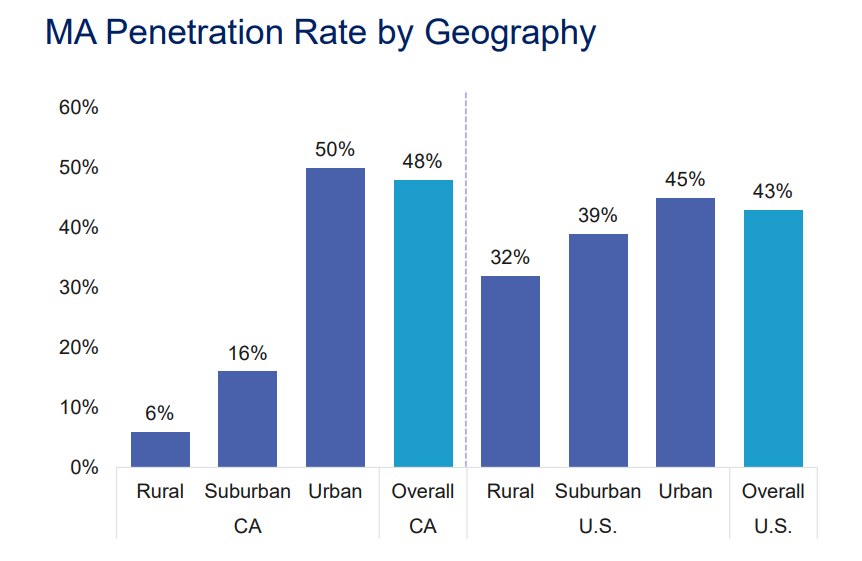
https://www.dhcs.ca.gov/services/Documents/OMII-Medicare-Databook-February-18-2022.pdf
That's a chart of Advantage plan by area.
Look at the split between rural and urban. Why?
Advantage plans are mainly HMOs, so they need lots of people (and providers) to make them work well.
Greater Los Angeles is the ideal place for this! See our Los Angeles Advantage plan comparison.
You can find zero premium and max out of pockets under $800 which is ideal for Advantage plans.
Go up to the Bay Area or down to San Diego and the max's quickly jump to a few thousand.
Now...it's harder to make that pencil out against a supplement. We explain why in our How to Pick the best Medicare Plan.
In some rural areas, you may not even have Advantage plans or just 1-2 which have the max problem.
Otherwise, it's also a function of cost.
We explain why people choose Medigap over Advantage plans in more detail, especially around how people are really missing 1/2 the cost equation when comparing the two.
So...within Medigap, how does it break down.
What are the most popular medigap plans in California?
The medigap plans breakdown this way for new enrollees:
- G plan - most popular and most comprehensive (covers Medicare Excess)
- N plan - adds in copays for office/urgent care (does not cover Excess)
- A plan - the lowest price generally - covers 20% coinsurance
In our review of how to Compare what medigap plans cover, we have the following breakdown:
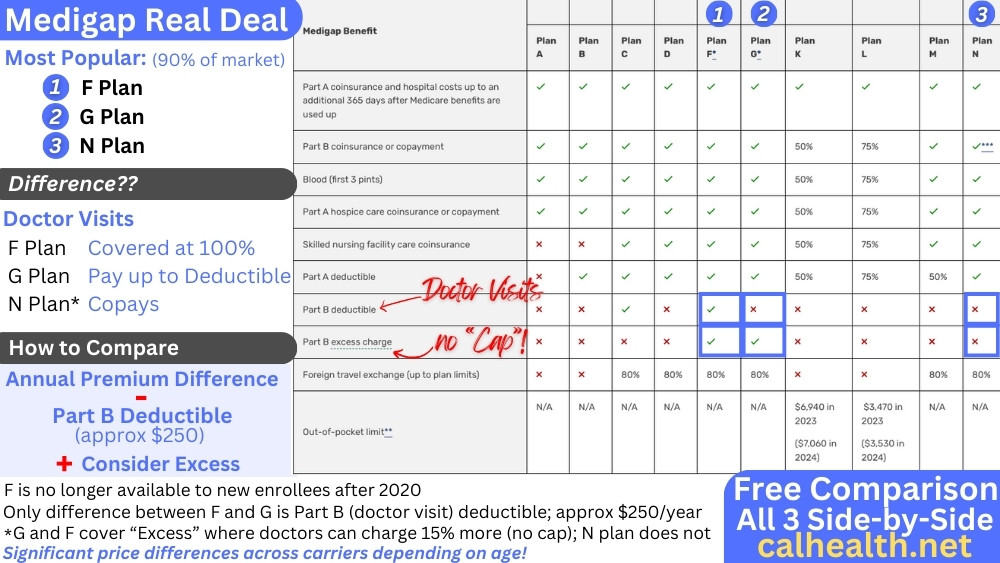
Here's the breakdown for the most recent year (2020) of California enrollment by plan type per the NAIC:
According to this report, the most popular Medigap plans in California in 2019 were Plan F (36%), Plan G (25%), and Plan N (16%).
The F plan is no longer available to new enrollees since 2020 (see if you should switch from F to G plan).
So...the G plan is roughly 25% of the market. N is 16%. Those have probably come up to 40% and 20% respectively.
We're amazed at how many people still have the old plans which can be much more expensive than equivalent G or lower plans.
If you have the F plan (and apparently, millions do in California), you absolutely must quote the new G plan as you're probably paying about $750/year+ more.
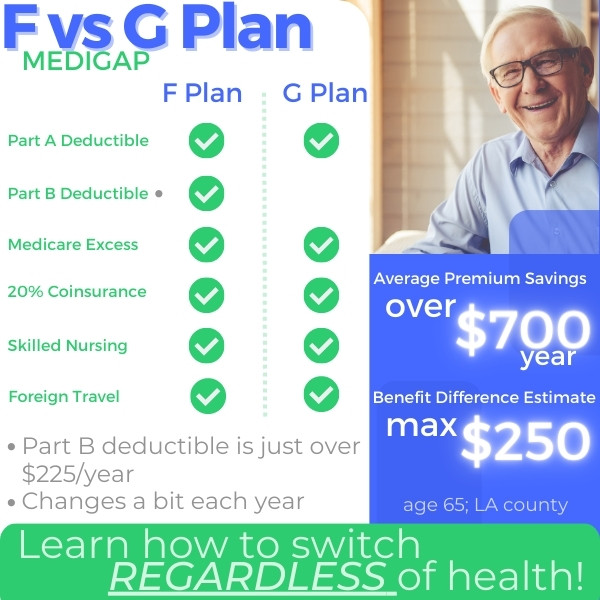
The old J and I plans also need to be quoted as well.
We've seen Humana and Cigna really price well depending on the area and age lately!
We go through the most popular medigap California carriers.
Speaking of which.
How to quote medigap plans in California
You can quote the dominant Medigap carriers all in one place:
The full array of dominant California carriers side by side!

There's no cost for our assistance and really do try to help people make sense of all this!